Everything on this site in one place: the published cost data, the blogs, the free tools, the video library, the problem guides, the comparison rows and the FAQ. No account, no fee, nothing to sign up for.
Start with a number
Know what your installation should cost before anyone quotes it. The cost guide sets out the published bands — 8 to 15 per square foot for installed artificial turf, 4,000 to 7,500 for a typical 500 square foot backyard, 4,970 (9.94 per square foot) for the modelled standard 500 square foot project and 6,827 (13.65 per square foot) for the engineered pet-proof system — alongside the competing options of natural grass at 0.50 to 2 per square foot for seed or sod and gravel and native planting at 3 to 8 per square foot installed. Behind it sit the per-square-foot build lines: turf and infill at 4.00 for a basic build with silica sand against 6.00 for rapid-drain turf with zeolite, labour at 5.50 against 6.50, aggregate at 48 per ton for #57 clean washed angular stone against 40 per ton for Class II road base, and a geotextile separator at 0.45 per square foot.
Read the blogs
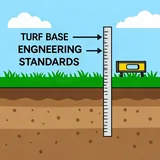
The blogs cover the build rather than the sales pitch: the complete turf guide and the 90 percent of the system nobody sees, what turf costs and where the money goes, the base engineering standards with the layer stack, the grade vector and the compaction number, the subgrade engineering walkthrough with the five layers and the three published failure modes, the 50-question installer vetting playbook and its 2-1-0 scoring system, the twelve-step installation guide from measurement to the settle period, the pet-owner FAQ on urine, odour, paws and digging, and the case for a professional installation over doing it yourself.
Use the free tools
The tools are the reason most people arrive, and every one of them is free and needs no account. There is a cost calculator built on the published per-square-foot rates with the 10 percent compaction buffer built in, a sub-base aggregate and compaction calculator that works from the 1 ton per 100 square feet baseline, a pet turf drainage and odour hazard estimator, a tarp-method deodorisation planner covering the 24 to 48 hour saturation treatment, a turf sizing, seams and waste estimator for rolls and joints, a turf temperature and paw safety diagnostic, and the turf knowledge quiz with its 19 questions on base, backing, infill and odour chemistry.
Watch
The watch page holds the explainer clips for this niche: how an installation actually runs from base prep to infill, why new turf smells like ammonia in the afternoon heat, the 48-hour odour cure, what is buried under a failed surface, the vetting checklist to run before any deposit, and the short drainage test. None of them is passed off as footage from a Boise installation — no clip filmed here is published yet, no date is promised, and the written guides cover the same ground in the meantime.
Know the problems before you spend
Artificial turf fails in patterns, and most of them are decided below the surface. The problem guides walk through poor drainage and pooling, heat retention and a surface too hot to walk on, pet urine damage and lingering odour, fading and infill compaction under traffic, and lifting seams and curling edges — each with what it looks like, what usually causes it, and how a professional would approach it. The severity ladder is worth knowing before you panic: minor cases may only need sealing or resurfacing, moderate damage may require section replacement or leveling, and severe structural issues typically need full replacement with proper site preparation.
How it works, who we are, and the FAQ
If you want to know what happens after you send a request, read how the free matching works — the under-two-minute description, the routing to up to three providers within one business day, and where our role ends. The about page sets out what we are and, more usefully, what we are not, plus how to check a professional before you hire. The FAQ answers the cost, base, aggregate, odour, infill, lifespan and maintenance questions with the published figures, including the transparency answers on payment, vetting and affiliation.
Frequently asked questions
Are the tools and guides free?
Yes. Every calculator, checklist, quiz and guide on this site is free and needs no account. The only form on the site is the optional quote request.
Where do the numbers come from?
The per-square-foot rates, aggregate quantities, compaction standards, drainage figures and lifespans are the published trade figures, quoted as published. The local detail — what the soil does, where water runs, which rules apply, and how hot the surface gets — belongs to the market, which is why it is stated per market rather than borrowed from another one.